Get more! Sign up for PLANSPONSOR newsletters.
Administration June 9, 2026
Creating Committees of Excellence
Crafting a successful plan committee usually includes outsourcing fiduciary responsibilities, customizing the structure and following plan documents.
Reported by
Emily Boyle

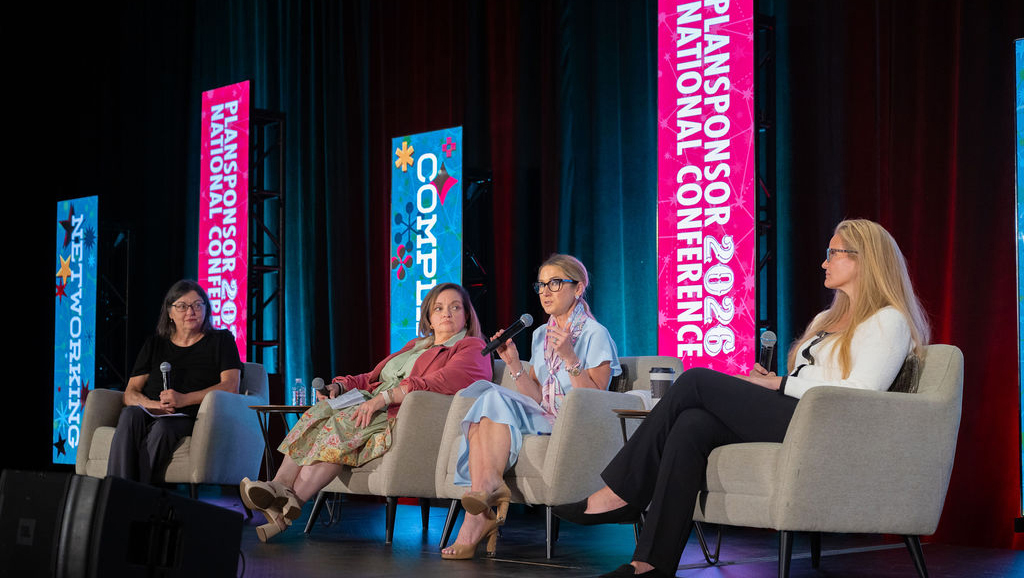
Gone are the days of a board of directors taking on sole fiduciary responsibility for a plan. Here is the era of delegating duties to a committee, according to speakers at the 2026 PLANSPONSOR National Conference, held last week in Nashville, Tennessee.
During the “Creating Committees of Excellence” session on June 1, panelists said among the ingredients to crafting an excellent committee are: outsourcing fiduciary responsibilities as necessary; knowing and following plan documents; and making sure the committee structures align with plan demographics and committee member strengths.
Outsourcing Responsibilities
Heather Bader, a partner in law firm Faegre Drinker, said that as committees face overwhelming amounts of responsibility and a threat of litigation due to their fiduciary liability, some are seeking ways to offload part of the pressure.
Over the course of the past 10 to 20 years, “committees are seeing they don’t have to do everything,” Bader said. “We’re starting to see the committees delegate some of that responsibility out through a prudent process.”
Some have outsourced responsibilities to 3(16) fiduciaries, 3(21) investment advisers and 3(38) investment managers for relief, Bader said. She predicted the trend will continue and evolve.
Knowing—and Following—the Documents
Bader said that while there is no requirement for plans to have governing documents, there is an obligation for plans to follow the terms of those they have.
“There’s been a huge push to having a charter, which is a great idea,” Bader said. “But the problem is that a lot of times, this charter [was] created in 2004, and nobody’s read it since 2004.”
The first piece of advice Bader had for plan committee members was to read, review and understand their charter and other plan documents annually. If the committee has a plan document, members should read that as well, to make sure it is consistent with the charter.
“The last thing you want to do is have something in your plan document that counters what your charter says,” Bader added. “If you’re going to have it, use it.”
Lisa Gomez, the former head of the Department of Labor’s Employee Benefits Security Administration who now runs LMG Collaborative Consulting Solutions, said she has advised clients that they are worse off having a document they fail to follow than not having a document at all.
“You don’t get credit for having all these things on paper somewhere if you don’t actually do them,” Gomez said. “Don’t say you’re going to meet quarterly if you don’t intend to meet quarterly.”
Kathleen Kelly, a managing partner in Compass Financial Partners, a division of MMA Securities LLC, added that she recommends incorporating document review into the new committee member onboarding process. During fiduciary training sessions for new committee members, her company includes a review of the plan charter and the investment policy statement, two of the documents Kelly said members should become familiar with out of the gate.
Structuring Committees
Gomez said there is no correct answer as to how many committees a plan should have. Rather, the number depends on what is most realistic, manageable and helpful for the plan sponsor.
“There is so much of a focus in this administration on process and trying to enable fiduciaries—who are putting … prudent processes in place—to have some more leeway in making decisions,” Gomez said, referring to comments earlier in the day by Daniel Aronowitz, the current head of EBSA. Aronowitz called the Employee Retirement Income Security Act a “law of process” and said the proposed rule on retirement plan investment selection would protect fiduciaries who follow a prudent process from hindsight-based litigation attacks.
Regarding the process for organizing plan committees, Gomez said the number of committees might also depend on the expertise among those able to serve. Having multiple committees may not be necessary if the members serving on a single committee are well-rounded in their understanding of finance, products and the employee population.
Plan size may also determine committee composition, Gomez said. A smaller plan may be limited in its resources, but a larger one, potentially with more resources and more complexities, may benefit from having multiple. Committees can be organized based on specialties, such as finance or product.
However, with multiple committees comes the risk of making decisions in “silos,” Gomez cautioned. She said she encourages committees to report to one another. In addition, an “overarching” committee could oversee the more specific committees, she suggested.
But no matter how many committees a company has—or who serves—Bader said employees must remember the “two-hat concept.” As a fiduciary, a committee member acts in the best interest of the plan participants. As an employee, a member acts in the interest of the employer, without respect to participants’ retirement plans.
“You’re going to really want to make sure you’re wearing your fiduciary hat,” Bader advised committee members in the room. “You [have] to take off your company hat.”
« Does ERISA Require a 403(b) Plan to Have a Committee Charter?