For more stories like this, sign up for the PLANSPONSOR NEWSDash daily newsletter.
Benefits June 10, 2026
How to Design a Plan: Prioritize Real Lives, Not Templates
Employers from Google to Prestage Farms said plan sponsors must look beyond one-size-fits-all retirement benefits and choose benefits based on their workers’ circumstances.
Reported by
James Van Bramer

The retirement plan that works for a highly paid software engineer may not work for a meat-processing plant employee who lacks regular internet access at work.
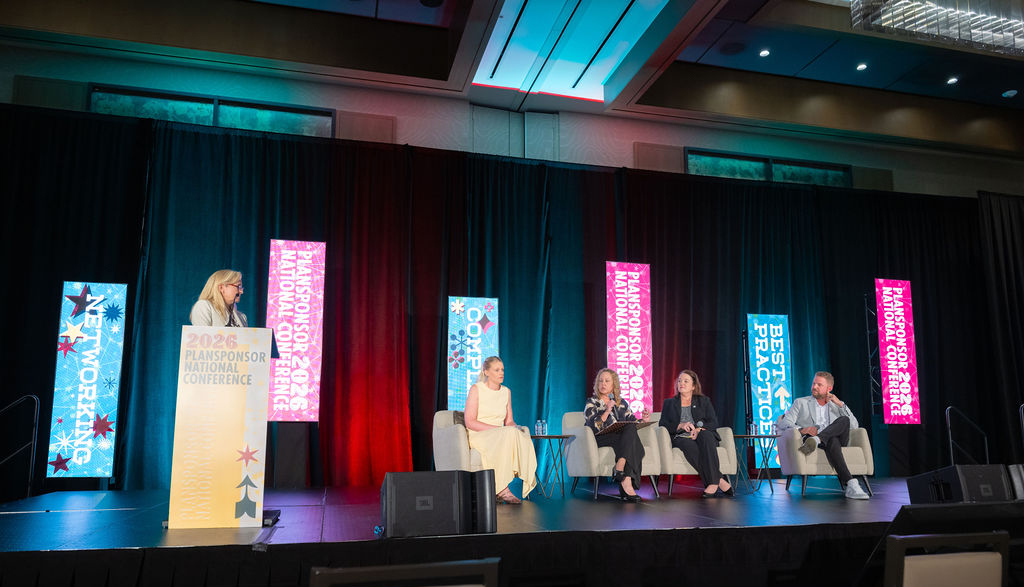
A more specific approach based on employee demographics was a central theme during a panel of award-winning employers at the PLANSPONSOR National Conference in Nashville, Tennessee, last week, where benefits leaders described how they are reshaping retirement programs around the needs of sharply different workforces.
In a session titled, “Practical Lessons From Plan Sponsors,” moderated by Kim Cochrane, director of client services at Hub International MidAtlantic, panelists from Google, Prestage Farms, Healthesystems and the National Federation of Independent Business said plan design has become less about adding trendy features and more about understanding employees’ financial realities.
The panel represented a wide range of employers, with vastly different numbers of participants and levels of plan assets:
- Google, with roughly 160,000 retirement plan participants and $71 billion in assets;
- Prestage Farms, a family-owned pork and turkey producer in North Carolina with slightly more than 3,000 employees;
- Healthesystems, a Tampa-based medical cost management solutions company with about 330 workers; and
- The National Federation of Independent Business, a nonprofit small-business advocacy group with about 600 employees across the country.
Strategies Tailored to Plan
For Kiley Jones, Prestage Farms’ human resources director, the most effective recent change for the plan was reenrolling employees into a target-date fund. Prior to that move, Jones said many of the plan participants had been with the company since its 1985 founding and were unaware of what they were invested in.
“Some of those same original employees are still with us today,” Jones said. “Some of those same original employees have never even touched their investments.”
Only about 20 employees opted out during reenrollment, she said, and those who did were mostly workers who were already actively managing their accounts and preferred to continue to do so.
At Healthesystems, Heather Stempien, its employee engagement and benefits director, said the company had focused on emergency access to savings, especially because the company’s headquarters are in Florida, where hurricanes and other weather-related events are a recurring concern and can cause financial hardships for participants. The company therefore adopted qualified disaster recovery distributions, streamlined hardship withdrawals, allowed a $1,000 annual emergency withdrawal and added an emergency savings account feature to its plan.
“We really wanted to give people the ability to access funds when they were in crisis,” Stempien said, “but didn’t want them to deplete their [retirement savings] while doing that.”
The NFIB took a different approach. Sara Udulutch, the organization’s employee benefits director, said its retirement committee decided not to add an emergency savings feature because NFIB already maintains an employee emergency relief fund created after Hurricane Katrina. Instead, the employer added in-plan Roth conversions in response to employee interest in tax diversification. The company also increased its employer match several years ago, she said.
An in-plan Roth conversion, offered by some plans, is when pre-tax retirement funds within an employer-sponsored plan are moved into a Roth account in-plan. In Roth accounts, participants pay income taxes on their contributions, and the assets grow tax-free and are withdrawn tax-free in retirement, options which may be attractive for younger workers or those expecting to have a higher income tax rate in later years.
Roth accounts are especially popular in individual retirement accounts. According to Fidelity, in the first quarter of 2026, IRAs experienced record-high contributions, which the firm attributed to strong demand for Roth accounts. Fidelity reported 67% of contributions going to Roth IRAs and a year-over-year increase of 41% in Roth conversion transactions for the period.
Google’s challenge is different than those faced by the other plan sponsors on the panel. Kyle Cotrufello, program manager for global financial and retirement benefits, said the company increased the deferral level for automatic enrollment to 10% of pay, up from 6%, after doing a retirement readiness analysis. The company also added an after-tax spillover feature once employees hit the federal 401(k) contribution limit. Google also recently added automatic escalation for workers still contributing at the default rate.
The company matches 50% of employee contributions up to the federal 402(g) limit, Cotrufello said, but many employees were not saving enough to receive the full match. The 402(g) limit is currently $24,500 for participants younger than age 50 and higher for older workers.
“We felt that we needed to be a little more aggressive, a little more courageous, with our plan design,” Cotrufello said, explaining why the company increased the autoenrollment level.
Communication a Major Focus
While each plan sponsor had unique goals for plan design, one similarity was the need to communicate effectively, even if the process was different for each.
At Prestage, where some workers lack smartphones, email addresses or reliable internet access, Jones said paper notices, break-room materials and face-to-face conversations remain essential. Employee “champions,” she added, can be more persuasive than formal communications from human resources.
At Healthesystems, Stempien said individualized outreach works best. Emails from broad inboxes are easy to ignore, she said, but a personal note from a familiar colleague often gets a response.
Google, meanwhile, relies heavily on timely, personalized messages tied to “moments that matter,” such as annual contribution-limit announcements, bonuses and savings milestones. But Cotrufello said employees also need human support, including office hours and access to financial planners.
The panelists also identified future plan priorities, including higher automatic deferral rates, stronger auto-escalation, student loan repayment benefits, health savings account investment education, and lifetime income options.
But the one universal message the plan sponsors all struck was that retirement programs should reflect the workforce they serve.
“Googlers have a very different need than [Prestage Farms],” Cochrane said.